 Genie
When Buying Got Faster Than Wanting
The pause between wanting something and owning it used to do quiet work for us, and now that commerce has removed it, the work is ours to do.
For most of history, wanting a thing and having it were separated by time. You had to save for it, travel to it, wait for it to arrive. Nobody designed that delay as a feature; it was simply the cost of living in a slow world. But it had a side effect we never noticed until it was gone: it sorted our desires. Some survived the wait and some quietly dissolved, and the ones that survived were usually the ones worth having. The law this essay is about is simple. When the time between desire and purchase disappears, we have to return it ourselves.
The distance that vanished
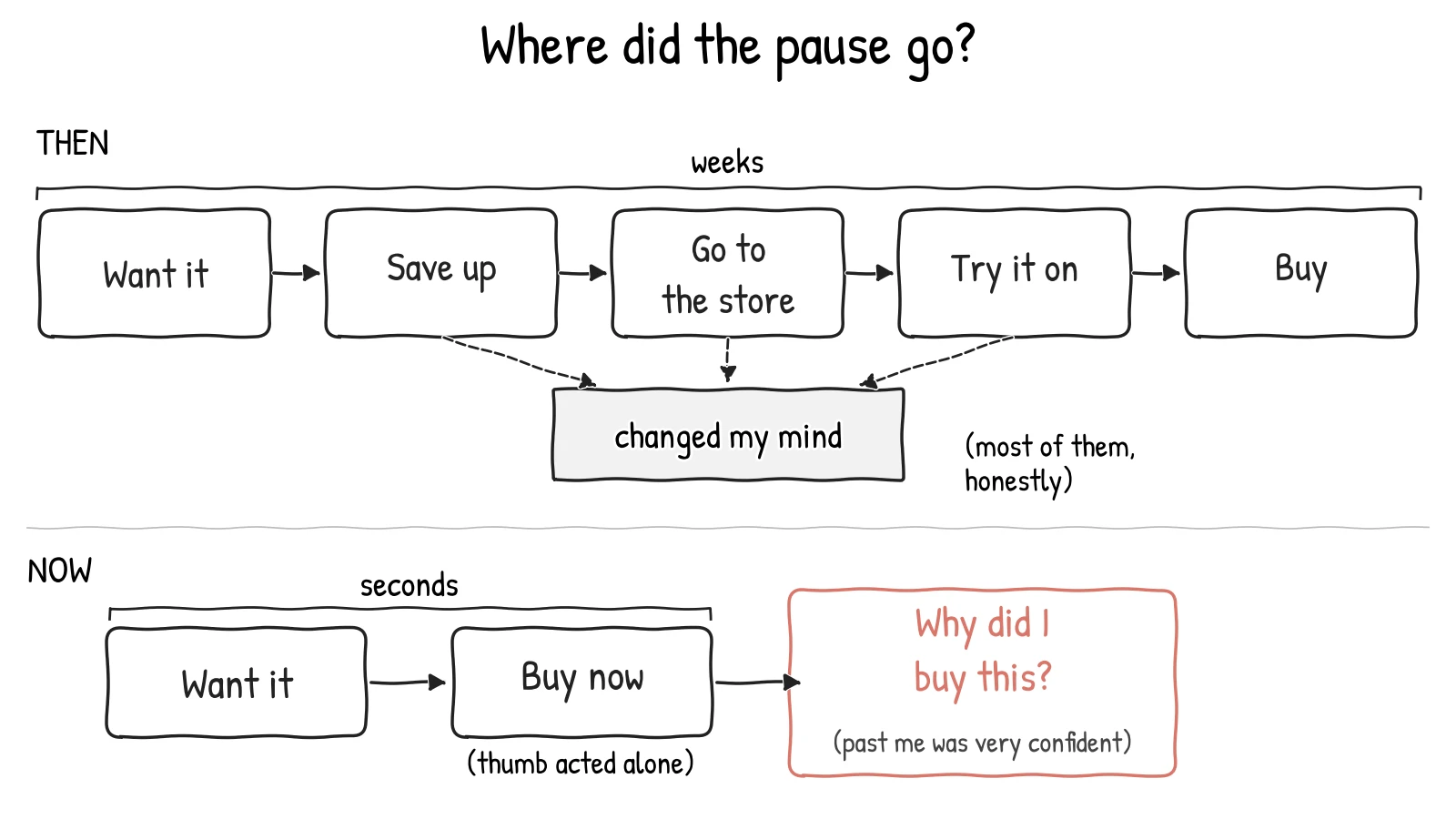
Look at what a modern checkout has removed. The card is saved, the address is saved, the size is remembered, and delivery is promised for tonight. Each of these is a genuine improvement, and none of us would want to go back to typing sixteen digits on a phone. Yet friction was never only an annoyance. It was also a filter. Every step between “I want this” and “it is mine” was a small chance for the wanting to be reconsidered.
Once those steps were engineered away, the decision itself shrank to the size of a tap. We now commit money in the time it takes to feel something, which means the feeling, rather than the person having it, increasingly makes the call. That is not a moral failure on our part. It is what happens to any system when you remove the delay that used to check its inputs.
A package for someone who has cooled down
There is a strange asymmetry built into fast buying. The purchase happens in a second, but the delivery happens days later, to a slightly different person. The one who ordered was excited, tired, cold, bored or lonely. The one who opens the box has usually moved on, and does not always recognize their own desire in what arrives.
Economists have found traces of this gap in surprisingly ordinary data. In a study of catalog orders (Conlin, O'Donoghue & Vogelsang, American Economic Review (American Economic Association), 2007), researchers found that cold-weather clothing ordered on unusually cold days was more likely to be returned. The weather on the day of the order leaked into a decision meant to serve the whole winter.
A purchase made in a second is delivered to a person who has already cooled down.
The returns are the visible part. The invisible part is everything we keep out of mild embarrassment: the gadget in a drawer, the jacket with the tags still on. Each is a small record of a moment that briefly spoke for us.
Two people in one body
The psychologist George Loewenstein gave this gap a name. In the paper Out of Control (Loewenstein, Organizational Behavior and Human Decision Processes, 1996), he argued that visceral states such as hunger, craving and arousal do not simply add weight to our preferences; they temporarily take their place. And the substitution is invisible from the inside. In a hot state, the desire does not feel like a passing condition. It feels like who we are.
The reverse error is just as real. In a cold state, we underestimate how strongly the hot state will pull, and so we make plans that assume a calmer self than the one who will show up. A simple demonstration comes from a snack study (Read & van Leeuwen, Organizational Behavior and Human Decision Processes, 1998). The researchers asked office workers to choose a snack they would receive a week later. People who were hungry at the moment of choosing picked unhealthy snacks more often than people who had just eaten, even though the snack was meant for a future that had nothing to do with their present appetite.
Put that next to a one-tap checkout and the problem becomes clear. A store that responds instantly is, in effect, taking orders only from whichever of our two selves happens to be awake.
Return the time, not the willpower
The natural response is to promise ourselves more discipline. It rarely works, and there is a reason. Psychologists have described what they call the restraint bias (Nordgren, van Harreveld & van der Pligt, Psychological Science, 2009): people tend to overestimate their ability to control impulses, and those most confident in their restraint were more willing to put themselves in the way of temptation. The belief in willpower turns out to be one of the things that weakens it.
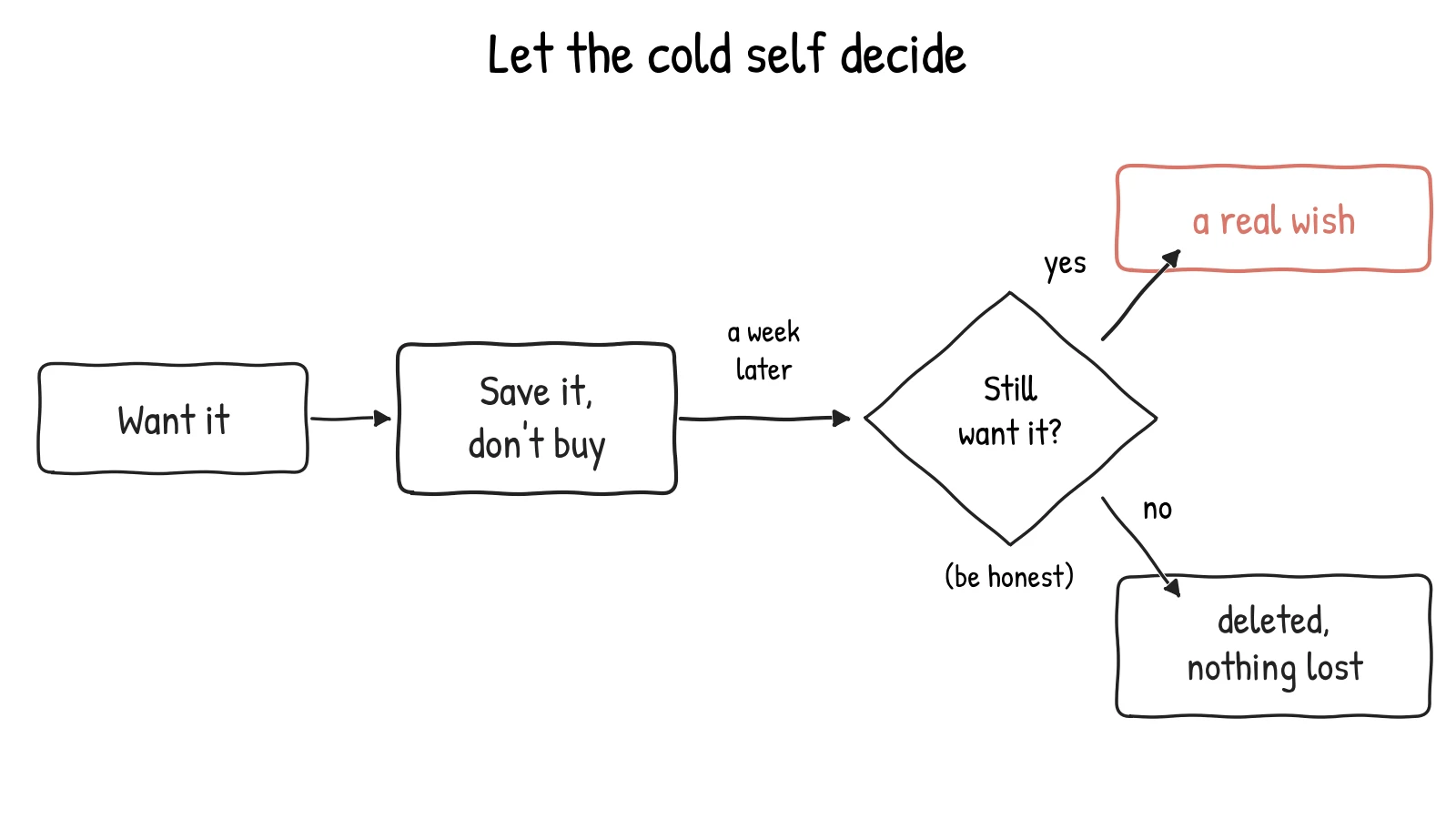
So the more reliable move is architectural rather than heroic. Instead of trying to win the argument with desire in the moment, we can change where the argument happens. The rule can be as plain as this: a desire is first saved, not bought. Saving costs nothing and loses nothing. It simply moves the decision out of the moment that produced it and gives it to a later, quieter version of ourselves. We are not resisting the impulse. We are scheduling it.
There is an obvious objection: every store already lets us save things. Amazon has its “Save for later” button and its wish lists, and most shops have a heart icon. But a pause is only as good as the place where it happens, and a store is the one place built to end it. A list kept inside a shop sits one tap from checkout, under prices that drop, banners saying only two are left, and recommendations for things we never asked for, so every visit becomes another hot moment rather than a cold one.
The store also never asks the question the pause exists for, whether we still want this at all; it only asks when we will buy. And because each store keeps its own list, our desires end up scattered across a dozen shops, where they can't be compared with each other or with the rest of our life. Saving a thing inside the store that sells it is like asking the seller to hold our wallet while we think. A real pause has to live outside the shop, in a place that has no stake in the answer.
When the impulse is right
It would be a mistake to treat the cold self as the wise one. Loewenstein's point cuts both ways: the cold state errs too, by underestimating how much something can matter. Some of the best things we own were bought on a hunch, and some of the things we talked ourselves out of we still think about years later. A rule that always sides with the cold self is just a different kind of bias.
That is why the pause is not a ban. It is a meeting place. The hot self brings the spark, the honest signal that something caught our attention. The cold self brings context: budget, use, whether we already own three of these. When a desire survives that meeting, it tells us something about the person rather than the moment. When it does not, nothing was lost except a package we would not have wanted to open.
Stores have spent two decades learning how to shorten the path from desire to purchase, and they have become very good at it. What has been missing is a tool built for the other half of the job: a place that keeps desires until they become clear. That is why Genie exists: save the spark when it appears, let it ripen, and keep what survives time, whether you eventually buy it for yourself or hand it to the people who want to delight you. It connects to an idea from our first essay, How to make a wishlist: a gift fails for lack of information, and a desire that has cooled and still holds is exactly the precise information a giver needs.
Further reading
- George Loewenstein on Hot and Cold Affect — Social Science Bites podcast, 2022. The idea in his own words, including why experience never quite cures it.
- Hot–cold empathy gaps and medical decision making — Loewenstein, Health Psychology, 2005. The short paper where the term itself is laid out.
- Projection Bias in Predicting Future Utility — Loewenstein, O'Donoghue & Rabin, Quarterly Journal of Economics, 2003. The economic model: we expect our future tastes to look like today's, including when we buy durable goods.
- Slow Dopa — Scott Galloway, No Mercy / No Malice, 2026. A blunt case for slow, compounding rewards over instant hits.
- Empathy Gap — The Decision Lab. A plain-language explainer with everyday examples.