 Genie
How to Make a Birthday Wish List, and Why Asking Is the Kind Thing
Every gift is a transaction of information before it is a transaction of objects. The person who gives brings money, time and goodwill, while the person who receives holds the one thing that decides whether any of it will land: the knowledge of what they actually want. When that knowledge stays where it is, the goodwill has nothing to steer by, and the gift becomes a guess wrapped in paper. Birthdays rarely suffer from a shortage of affection. They suffer from a shortage of data, and almost everything awkward about them follows from that.
The ritual of "nothing"
The conversation is so familiar that it has become a ritual. Someone asks what you would like for your birthday, and you answer that you need nothing, that their presence is enough, that they really should not bother. The answer is sincere in its intention and useless in its content. Naming a wish feels like asking for something, and asking for something on the one day dedicated to yourself feels like greed, so modesty quietly closes the only channel through which the useful information could travel.
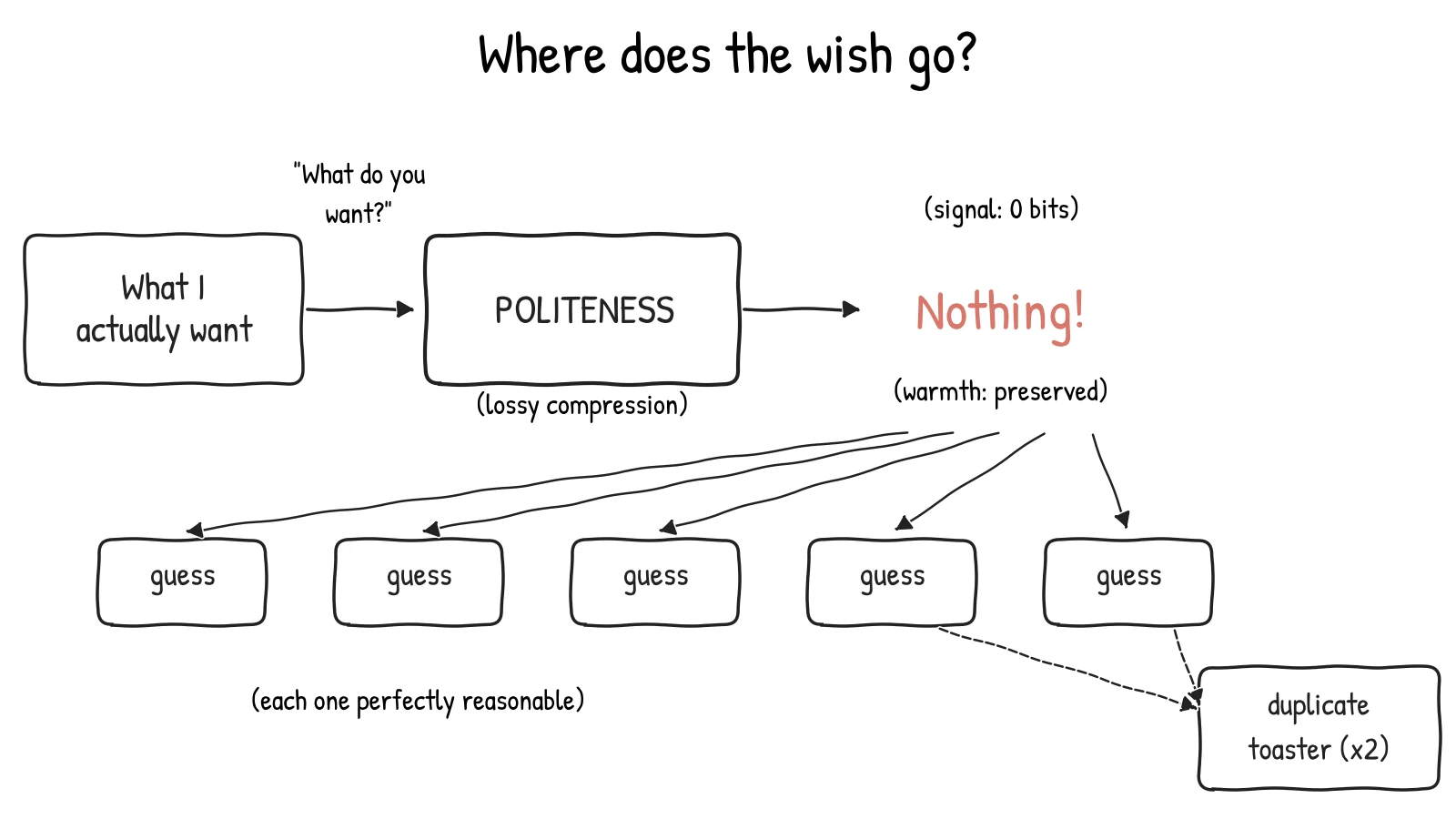
The giver, meanwhile, hears the refusal for what it is, a polite noise rather than an instruction. Nobody actually arrives empty-handed after being told "nothing", so the question is not answered but merely transferred: the giver is left to reconstruct a wish from scattered memories, half-remembered remarks and whatever the shops happen to suggest that week. Politeness, in this exchange, behaves like a lossy compression algorithm. It preserves the warmth of the message and discards almost all of its meaning.
Politeness preserves the warmth of the message and discards almost all of its meaning.
What the evidence says about asking
We tend to believe that a gift chosen without help proves more care than a gift that was requested, as if guessing correctly were itself the present. Research on gift exchange suggests that this belief belongs almost entirely to the giver. In a series of experiments, recipients were consistently more appreciative of gifts they had explicitly asked for, and even judged them more thoughtful and personal, while givers expected requested and unrequested gifts to be valued equally and assumed that their own inventiveness would be noticed (Gino & Flynn, Journal of Experimental Social Psychology (Elsevier), 2011). The same studies found that the more specific a request was, the more willing givers became to follow it.
A broader review of the field explains why the two sides keep missing each other. Givers instinctively optimise for the moment of opening, for the surprise and the visible delight, whereas recipients evaluate a gift by how useful and welcome it remains in the months of ownership that follow (Galak, Givi & Williams, Current Directions in Psychological Science (SAGE), 2016). A guessed gift is built for a single minute of unwrapping, while a requested one is built for the year that comes after it, and it is the year that the recipient actually lives through.
The price of guessing
Economists have tried to measure what guessing costs. In a well-known study of holiday gifts, recipients valued what they received at between a tenth and a third less than the givers had paid, and the losses were largest for gifts from more distant relatives, the people who know the least about our current lives (Waldfogel, American Economic Review (American Economic Association), 1993). The money is not wasted out of carelessness. It is wasted because good intentions were forced to work without information.
A birthday concentrates exactly this problem. The guest list usually reaches beyond the closest circle to colleagues, in-laws and the parents of a child's classmates, each of them sincere and each of them working from a thin file. Because they guess in parallel and cannot see one another's choices, they also produce the most recognisable birthday failure, the duplicate: two identical boxes on the same table, each a perfectly reasonable guess and together an obvious sign that the system had no shared memory.
Is it rude to send a birthday wish list?
The suspicion is old and not unreasonable, and the internet answers it bluntly: "No, your friends are not Santa," as one answer on Quora puts it. A specific list, with items, links and prices, quietly changes the nature of a gift: what was a gesture becomes a transaction with terms, and a transaction creates an obligation. Once there is an obligation, there is also a ledger, the half-conscious bookkeeping of who gave what and what is now owed in return. The expectation of reciprocity does not come from the gift itself but from the terms placed on it, and the more precise the terms, the louder the ledger.
Whether that ledger is welcome depends on distance. Anthropologists have long described a spectrum of exchange: among the closest people, giving flows without accounting, while toward the edges of a social world every gift is expected to be balanced by an equivalent return (Sahlins, Stone Age Economics (Aldine), 1972). In the late 1970s the psychologists Margaret Clark and Judson Mills noticed that the same favour could warm one relationship and chill another, and they proposed a distinction that has shaped the study of close relationships ever since. They called the first kind communal relationships: the bonds we have with family, partners and close friends, where people give because the other person needs something and feel uneasy when a favour is promptly repaid, as if repayment turned care into a deal. They called the second kind exchange relationships: the bonds with colleagues, acquaintances and business partners, where people keep track of what they have received and expect benefits to be returned in kind (Clark & Mills, Journal of Personality and Social Psychology (American Psychological Association), 1979). The distinction matters here because a birthday sits on the border between the two: the same occasion gathers both circles around one person, and each of them hears a request through its own rules. The same list therefore means two different things. Handed to a partner or a close friend, it reads as trust. Handed to a colleague, it reads as an invoice, and it invites exactly the bookkeeping that a birthday should be free of.
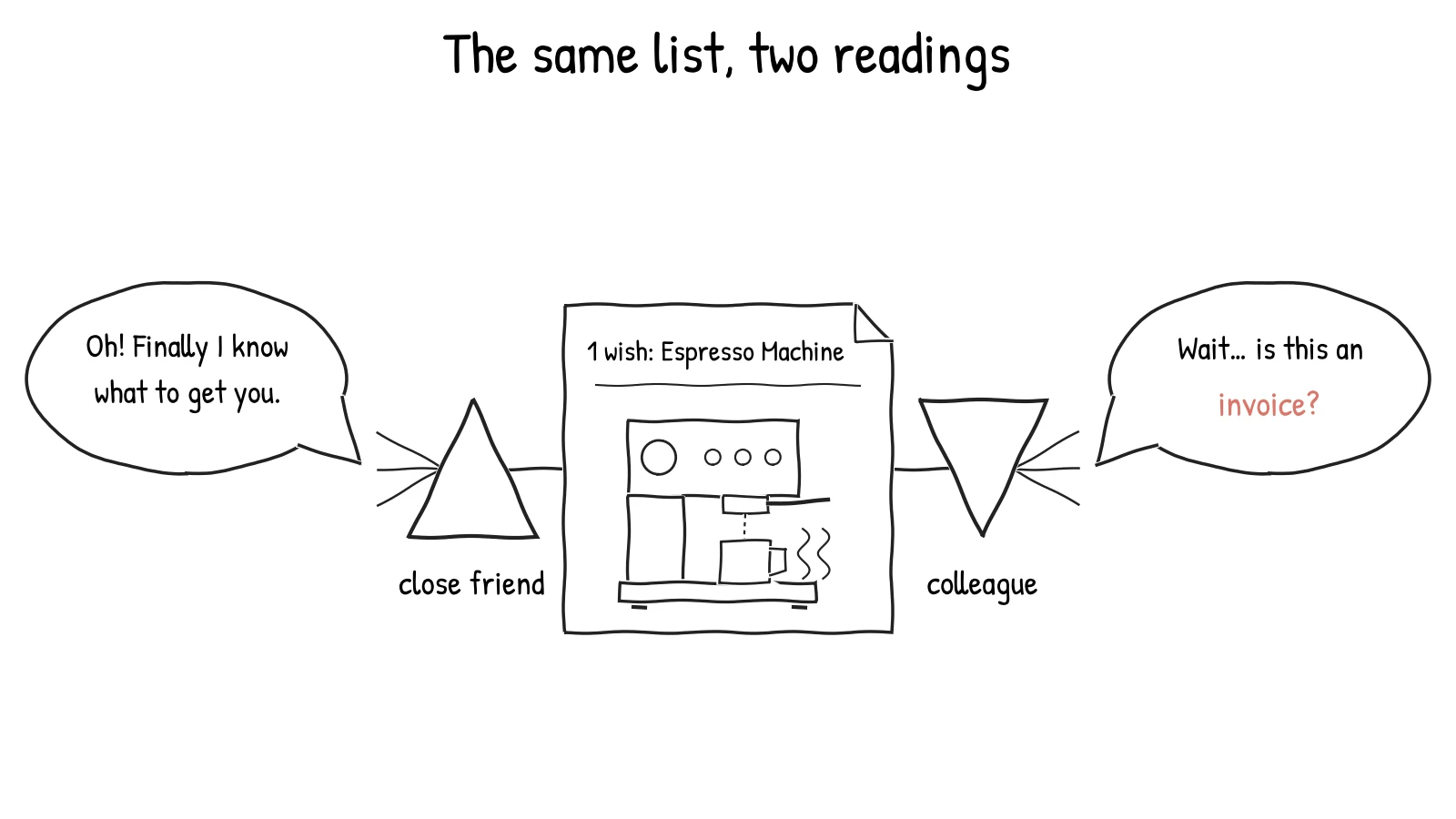
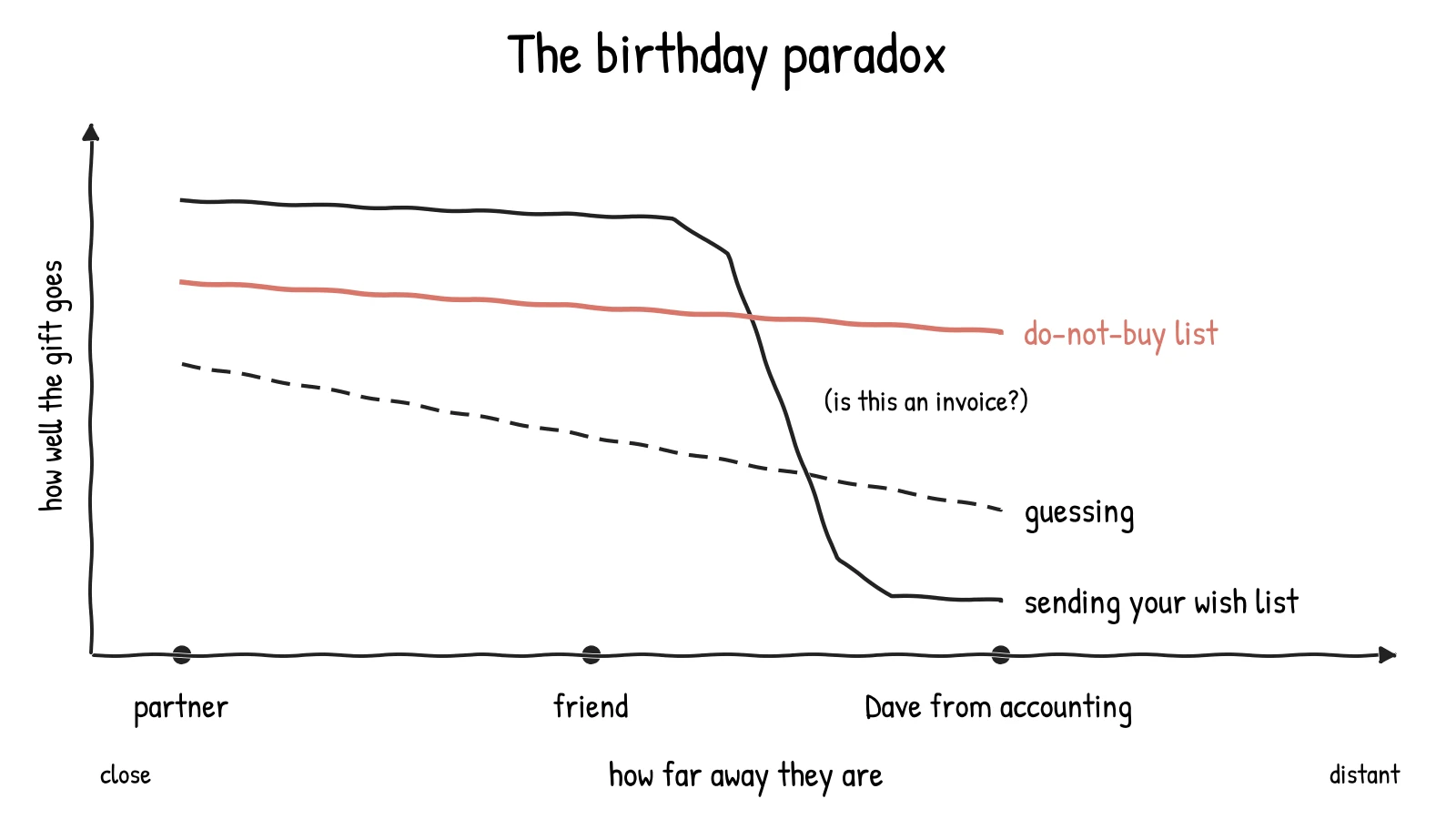
This creates a paradox. The people furthest from us know the least about our lives, and Waldfogel's data show that their gifts lose the most value: of everyone around a birthday, they are the ones who most need precise information. Yet they are also the ones most likely to resent receiving it. For a colleague or a distant acquaintance, a list does not feel like help but like a summons, a reminder that a gift is expected, that its contents have been decided for them, and that the exchange will be noted. The very document that would rescue their guess is the one that turns their goodwill into a duty. The resolution is that distance should change the resolution of the information, not remove it. The outer circle needs orientation rather than orders: what you love, and what you would rather not receive, such as the scented candle for someone who dislikes scents, the diet book that reads as a hint, the box of chocolates for someone with an allergy. The inner circle can have the list itself. The law is simple: the closer the person, the more specific the wish.
Birthday wish list etiquette: do and don't
Do
- Share a specific wish list with your partner, family and closest friends, especially once they have asked.
- Answer "what do you want for your birthday?" with something real instead of "nothing".
- Give the wider circle a direction rather than a list: what you love, and what to avoid.
- Where a list of what to give would feel rude, offer a do-not-buy list, sometimes called an anti-wishlist: allergies, things you already own too many of, things you will never use. Nobody resents being spared a mistake.
- If you would rather receive no gifts at all, say so once, warmly and in advance, and suggest what you would welcome instead, such as their company.
- Include more ideas than one person could buy, across different prices, so that choosing remains a choice.
Don't
- Send a list to people who have not asked, or who were not planning to give anything.
- Attach a list to an invitation for colleagues or acquaintances.
- Treat the list as an order: nobody owes you an item from it.
- Keep score of who gave what, or measure your next gift by the last one.
A protocol, not a demand
A birthday wish list is the simplest correction to all of this, and it works because it changes the structure of the exchange rather than the character of the people in it. Instead of one person being asked the same awkward question many times, the answer is published once, in advance, at a link anyone can open. Instead of mind-reading, the giver receives data. Instead of several people buying the same thing in isolation, they share a single state in which a gift, once chosen, is visibly taken.
Seen this way, making a birthday wish list is not an act of asking for things but an act of consideration toward the people who will have to choose. It spares them the evening of anxious searching and the quiet fear of getting it wrong. Nor does it destroy surprise, as people often worry it will. The surprise simply moves from ignorance to choice: you still do not know which of your wishes will arrive, from whom, or with what note attached, and that uncertainty turns out to be enough.
Wishes do not appear on the eve of a birthday. They accumulate quietly over the whole year, in a book someone mentioned, an object seen in passing, a thing we noticed and then forgot, and the problem has never been that we want nothing but that we cannot remember what we wanted when the question finally comes. A birthday wish list, properly understood, is a memory of your own wants, kept as the year goes by and shared at the distance each relationship can bear. Genie is built around those distances: everyone gets a reminder that the day is coming, which is simply a reminder to say happy birthday; acquaintances can see what you love and a do-not-buy list, which asks nothing of them and only spares them a mistake; and only the people closest to you are invited to the list itself.
Further reading
- Gino & Flynn, Journal of Experimental Social Psychology (Elsevier), 2011: the experiments on requested versus unrequested gifts.
- Stanford Graduate School of Business, "Give Them the Gift They're Expecting": a plain-language account of the same studies, including the birthday wish list scenario.
- Galak, Givi & Williams, Current Directions in Psychological Science (SAGE), 2016: why gifts that are great to give are often not great to get.
- British Psychological Society Research Digest, "The psychology of gift giving": a short review of research on what makes a gift welcome.
- Sahlins, Stone Age Economics (Aldine), 1972: the spectrum from generalized to balanced reciprocity.
- Clark & Mills, Journal of Personality and Social Psychology (American Psychological Association), 1979: communal and exchange relationships.
- Waldfogel, American Economic Review (American Economic Association), 1993: the original estimate of the value lost to guessed gifts.